Materials and making
One visible material, one grille cloth, and nothing else.
Solid quartersawn hardwood, machined and hand-finished. Not veneer, not MDF, not plastic pretending.
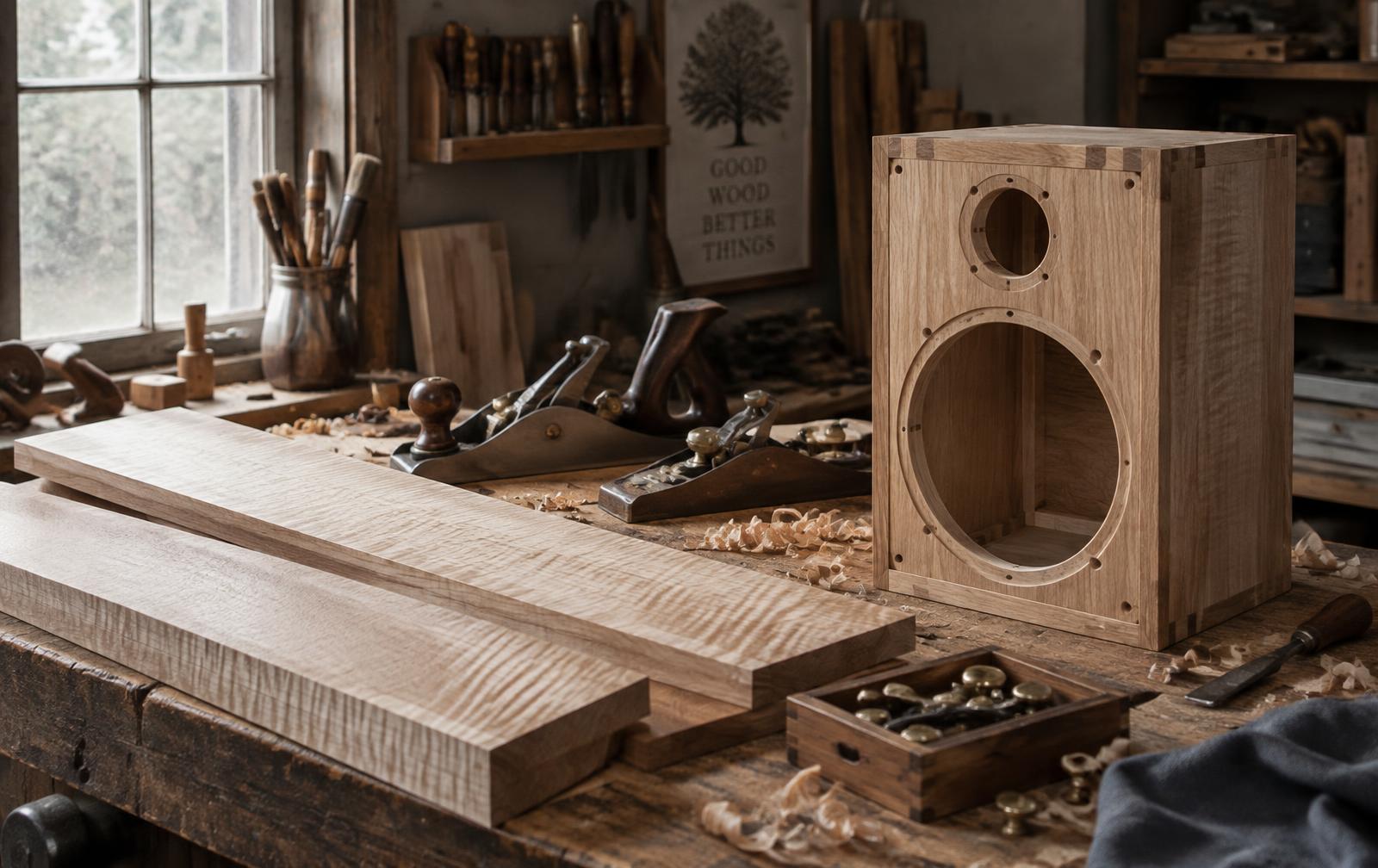
The wood
Quartersawn, because it stays where you put it.
We buy European ash and oak, and American black walnut, in boards rather than sheets. Quartersawn stock moves less across the grain than flatsawn, which matters in a kitchen where the humidity changes twice a day.
Boards are matched by hand for each cabinet so the grain runs continuously around the corners. Offcuts too small for a cabinet become the feet.
Machining and finishing
Cabinets are cut on a small CNC to keep the joints tight and the baffle apertures true, then finished entirely by hand: planed, scraped and sanded through four grits, then oiled. There is no lacquer and no filler.
The finish is matte. Every surface is a plane or a radius — no decorative features, no fake seams, no elements that exist to look technical. There is no branding on the face of any object.
Grille cloth, brass, silicone
- Grille
- Undyed wool, woven in Yorkshire, tensioned on a removable frame
- Dial and encoder
- Machined brass, unlacquered, left to dull with handling
- Fasteners
- Stainless machine screws into brass inserts — no glued seams
- Calliope buttons
- Cast silicone, food-grade, replaceable as a set
- Feet
- Offcut hardwood with a wool washer
- Finish
- Hard-wax oil, three coats, renewable at home
Numbers
Hand-built in small numbers.
The first run is 120 of Muse, 120 of Clio and 90 of Calliope. One cabinetmaker and two assemblers build roughly thirty objects a month between them, and each one is signed inside the back panel — where you will only see it if you open the object, which you are allowed to do.