For Calliope families
Voices
Ninety minutes, in three sittings, at a kitchen table. What comes out of it is a shelf of stories in one person's voice.
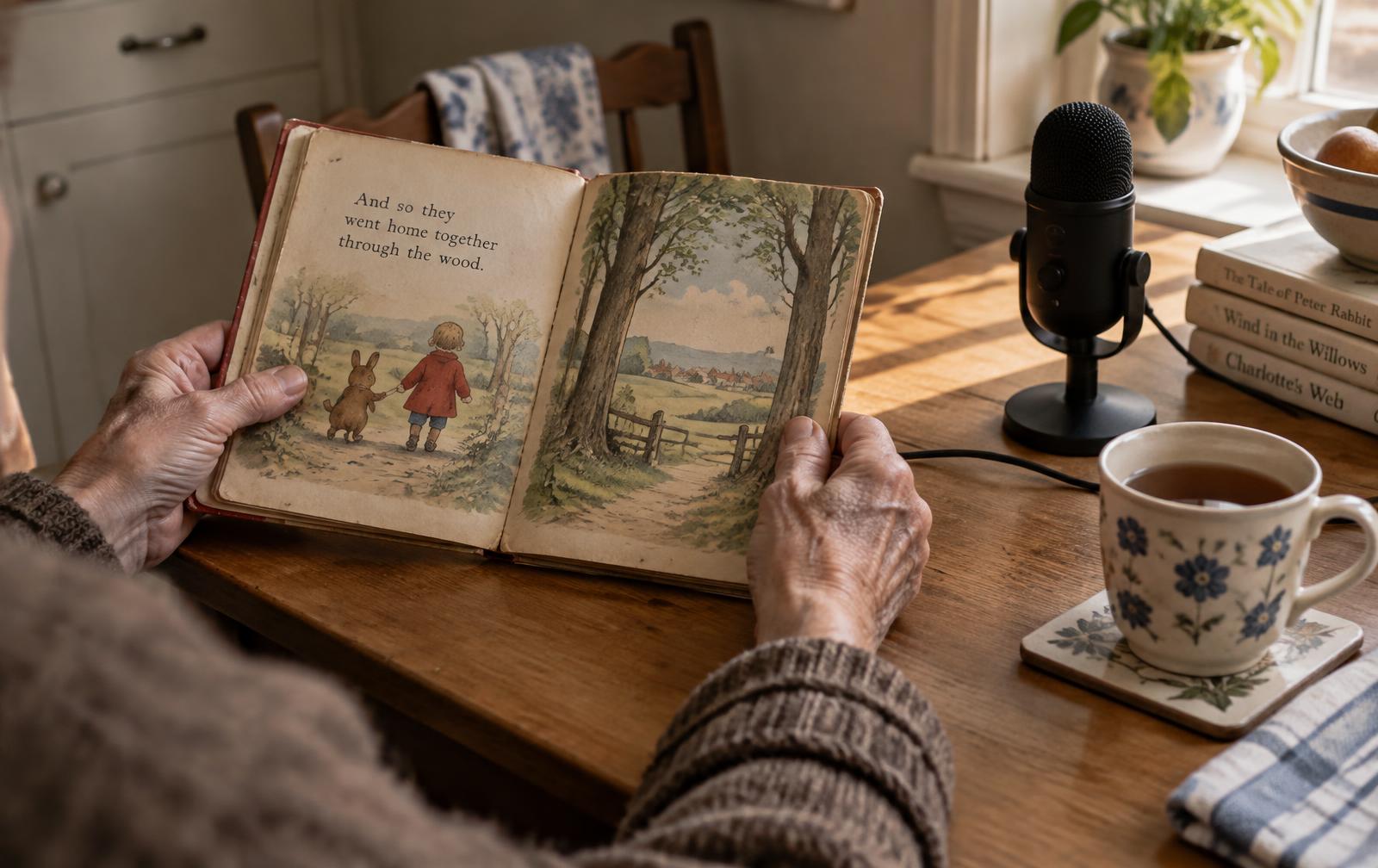
The three sittings
Sitting One
about 35 minutes
The books you already own
You read three or four of them, start to finish, at your own pace. We send a small microphone and a printed card with the only two instructions that matter. Nobody is directed, and nothing is re-recorded for polish.
Sitting Two
about 30 minutes
The passages
A set of short readings that carry the shape of a voice — its pauses, its vowels, its way of arriving at the end of a sentence. This is the sitting that allows longer works to be narrated later, if the family asks for it.
Sitting Three
about 25 minutes
The small things
Good night. Sleep well. A name, said the way only one person says it. These are the pieces families come back to most, and they take the least time to record.
What is read, and what is generated
Every story on a Calliope carries one of two marks, and the family can see which is which at any time. Read means the person sat down and read it. Narrated means we produced it from their recordings so a longer book could be heard in their voice.
We never blur the two, and we never present one as the other. The distinction belongs to the family, not to us.
- Read — marked ■
- Recorded start to finish by the person themselves. Their pauses, their mistakes, their laugh at the same page every time.
- Narrated — marked □
- Produced from their recordings, with their written permission, so a longer work can be heard in their voice. Always labelled, never mixed into a read story.
Consent, and who holds it
The recordings belong to the person who made them. They can ask us to stop producing narrated stories at any point, and they can ask us to delete the recordings entirely. If they do, the stories already on the device keep playing, because the device does not need us.
Nothing is used to train anything shared between families. One voice, one family.